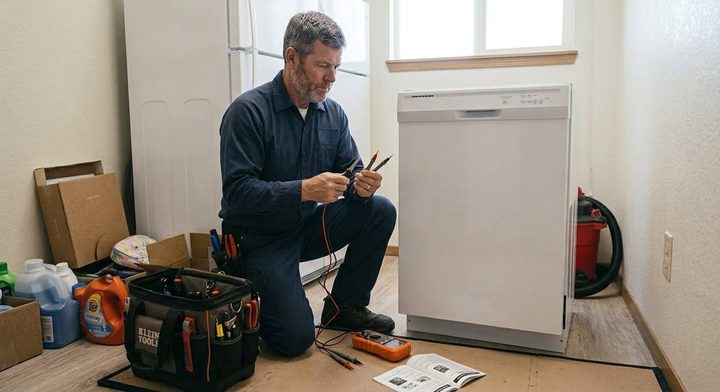
A dishwasher is undone by what it swallows more than by what it's made of, so the visit begins at the bottom, where the evidence gathers — and a pleasing number of folders close without a single part.

The first act of any dishwasher house call is unglamorous: the sump comes open, and its archive — seeds, labels, a sliver of yesterday's wine glass — gets read like a diary. A patient excavation of the filter stack and chopper resolves a striking share of complaints, much of it needing nothing beyond the visit itself — no hardware at all. Pumps, valves and latches meet the meter only after the sump has shown itself clean, and control boards answer questions last, strictly on evidence.
Two checks ride every visit in this town: intake warmth, because lukewarm supply defeats the best machine ever built — a quirk of the long pipe runs in the older houses — and the drain path under the sink, where a low loop invites the sink's water back into a clean machine. The $99 service call covers the visit and the assessment; any repair is quoted in ink before it begins, parts itemized for approval, and findings that belong to a plumber leave as a written referral rather than an appliance charge. Ending at the findings keeps $99 as the entire bill — no persuasion attached.
Ten seconds at the sink sends the machine hot water from the first fill — the single cheapest improvement to wash quality in an older house.
Modern machines want to see a little soil to judge the load, but pits, labels and toothpicks belong in the bin, not the sump's archive.
Two twists, a rinse under the tap, done. The households that do this simply don't meet us for standing-water calls.
Seeds, labels, a sliver of glass — the archive under the filter explains more failures than any board. A thorough clearing is often the whole cure, and a pleasing share of visits end right there — inside the service call.
The intake's warmth gets read because lukewarm supply washes badly through no fault of the machine's — a long-pipe quirk of the older houses that no part will ever fix. The honest cure is often at the sink, not in the cabinet.
Water on the toe-kick gets followed to its source — boot, hose, valve or door — with the machine opened properly. Leaks are never diagnosed from above in this practice.
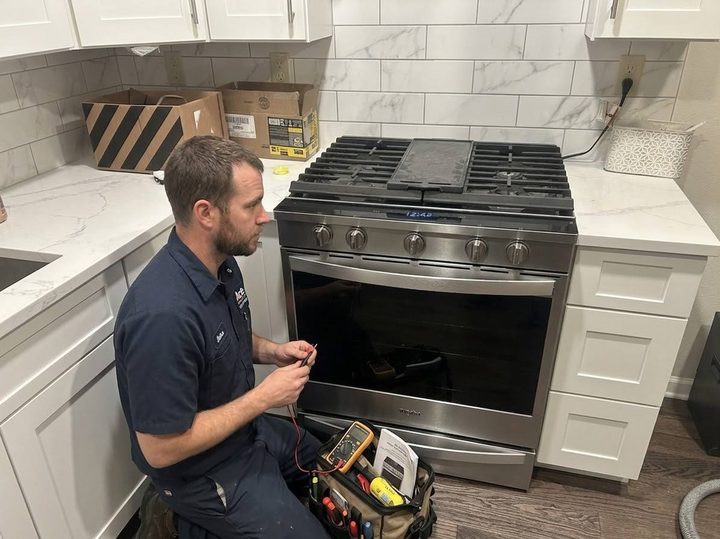
Control electronics are questioned only after the mechanical suspects have cleared, and convicted only by meter. It's the expensive part of the machine and therefore the last to be accused — a sequence that keeps folders honest.
Half the time the culprit is the sump's collection or a pinched hose, put right with labor alone. A pump earns replacement here only once the sump shows clean and the windings disappoint the meter — a guilty sound has never yet purchased a part in this practice.
Sometimes the spray path is starved by debris; sometimes the water and detergent simply disagree. The assessment sorts mechanics from chemistry honestly — and if the honest answer is technique or temperature rather than parts, that's what you'll be told, free of any fitting.
Seldom — thermal fuses and controls bear surges poorly. The consolation: surge casualties tend to be the modest parts, and they answer to the meter first on every after-outage visit.
Not a cent — a word when arranging brings the proper approach along. Integrated, portable and freestanding machines all get the same arrangement — and cabinetry has never changed a quote.
The home district — brick streets, hill Victorians, the easiest windows in the book.
Family craftsman homes and the university's hardest-working rental machines.
Lofts, condos and century bungalows — freight elevators and alleys, planned for.
The keep-it-running streets — veterans repaired on principle, garage fridges included.
The young stock — warranty checked free before any fee, cohort patterns named.
The lake road — outage-surge fluent, provisions taken as seriously as kitchens.
Send the symptom through the form, or call (564) 221-8172 and talk it over plainly.