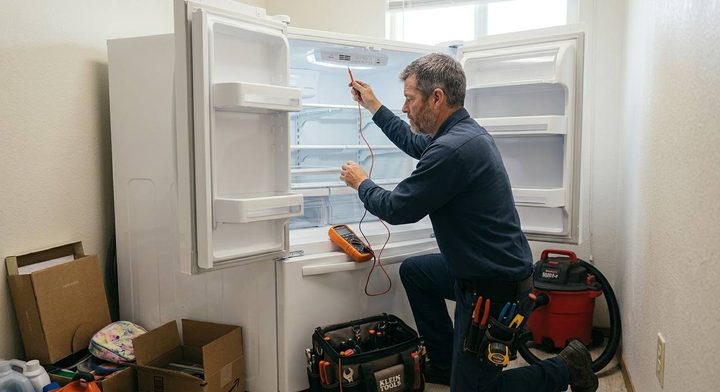
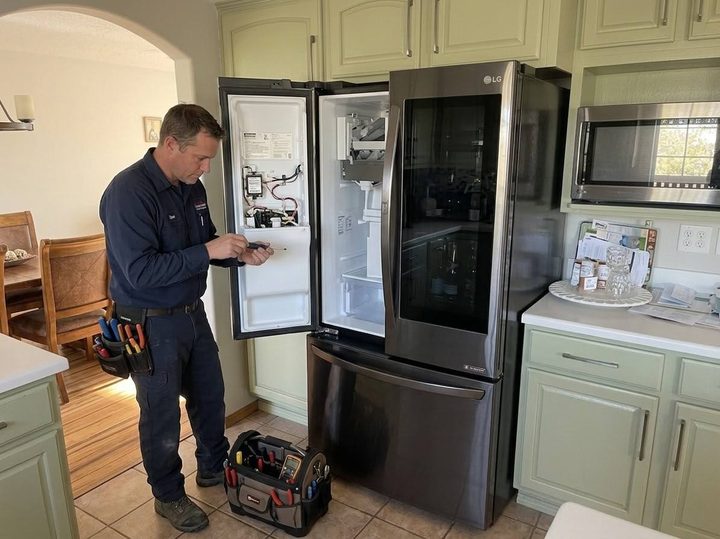
A warming refrigerator outranks everything else in the book — and the inexpensive suspects get proven before anyone says a heavy word like compressor.

Refrigeration rewards patience and punishes leaping to conclusions, so this practice works up from the inexpensive end: dusty coils and tired gaskets before anything else, then defrost hardware and circulation fans, with the compressor and sealed system reached last and only on evidence. Most of Bellingham's warm refrigerators are cured on the ladder's lower rungs — and after a windstorm takes the power out, the start relay is proven before anything is mourned, because a surge casualty imitates a compressor funeral for a fortieth of the price.
The household's cold is treated as the small emergency it is: a kitchen unit losing its chill heads the day's book, and a chest freezer guarding a garden year books ahead of everything with a pulse. The $99 service call covers the visit and the whole climb up that ladder; the repair itself is quoted in writing before it starts, components itemized for approval, sealed-system conversations held before commitments, and when retirement is the honest advice you'll have it written, for $99, with a word on what tolerates a damp garage or a cellar's temperament.
Ten minutes with the brush attachment is the cheapest refrigeration service in existence. Dusty coils make cold expensive long before they make it impossible.
A gasket that won't grip a slip of paper is letting the room in. Seals age faster near salt air and cellar damp — caught early, they're a modest item.
Unheated rooms swing wider than household thermostats care to follow. A garage unit acting seasonal sometimes wants relocation or settings rather than repair — counsel this practice gives freely.
Warming cold claims the day's first opening, and the intake call carries the practical advice — doors shut, towels at the gasket if it's icing — that buys hours before the van arrives. A full freezer holds longer than fear suggests.
Coils and gaskets, then defrost and fans, then and only then the compressor conversation — each rung tested and named aloud as it clears. You're welcome to watch; most households do, and the narration is free.
A click-and-silence rhythm points at start hardware far more often than the compressor itself — a modest part proven with a meter in minutes. Post-outage weeks fill the book with exactly these rescues.
A sealed-system failure in an old unit gets called what it is, in writing, with the assessment fee covering the knowledge. What follows is advice suited to your kitchen and this damp county — never a commission.
Keep the doors shut and ring the shop. Closed up, a refrigerator keeps useful chill for hours and a loaded freezer for a day or better — and troubled cold heads the book's first opening, whichever neighborhood rings.
Usually not — that rhythm is the start relay's confession more often than the compressor's, especially after an outage. It's an inexpensive part proven with a meter in minutes, and most such machines are cooling again before the van leaves the curb.
Often, honestly, yes — three of the four common failures cost a small fraction of replacement. When the arithmetic argues otherwise, the assessment says so in writing for $99, and you shop with facts instead of a salesman's weather report.
Weekly — South Hill and Edgemoor keep a fine stock of them, and instrument-led assessment matters most precisely there. Mention the cabinetry when arranging and the right approach arrives with the van; trim has never moved a quote here.
The home district — brick streets, hill Victorians, the easiest windows in the book.
Family craftsman homes and the university's hardest-working rental machines.
Lofts, condos and century bungalows — freight elevators and alleys, planned for.
The keep-it-running streets — veterans repaired on principle, garage fridges included.
The young stock — warranty checked free before any fee, cohort patterns named.
The lake road — outage-surge fluent, provisions taken as seriously as kitchens.
Send the symptom through the form, or call (564) 221-8172 and talk it over plainly.