In a town this damp, the dryer is half the household's weather system. When it falters, a careful assessment finds the true fault — and the quote you approve is the quote you pay, in writing.
$99 service call · your exact figure in writing before any work · parts itemized for approval
$99 service call — the assessment, at your doorYour figure in writing before any work beginsParts itemized, fitted only after your approvalWarranty written into the folder you keep
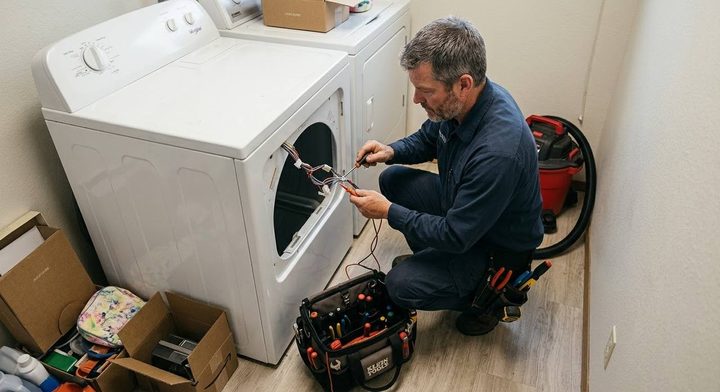
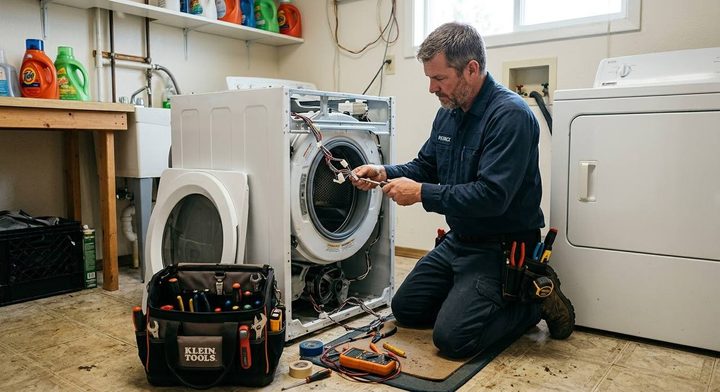
Dryer Repair on a Bellingham house call — the practice's own hands, not a stock catalog.
Bellingham dries laundry indoors ten months of the year, and its dryers earn their keep in houses of every age — bungalow basements where the vent snakes twenty feet to daylight, hillside laundry closets, new-block stacks. The care visit begins with the airflow, not the parts shelf: the exhaust is measured, the duct walked, the outside flap checked, because in this climate a suffocating dryer imitates a broken one more often than anywhere we know. When the remedy is a careful clearing, it lives inside the service call and the folder closes with its parts column empty.
When a component has honestly failed, the meter names it before anything gets bought — elements and igniters proven, thermostats and fuses checked in their order, rollers and belts judged by hand. The money stays orderly: the $99 service call covers the visit and the assessment, your machine's exact figure follows in writing before a single repair task begins, and every part is itemized at its own price for your approval. And when the kindest counsel is retirement, it arrives in ink for $99, along with a considered word about what an old house's circuits will welcome before you shop.
The owner's page
Keeping a dryer well, between visits
The screen, every load
Not most loads — every one. It is the least glamorous habit in the house and the one that buys a dryer years. A clean screen also happens to be the cheapest fire precaution ever sold.
Walk the vent once a year
Pull the machine gently, look at the duct, feel the outside flap while it runs. In this climate lint packs damp — if the flap barely stirs, arrange a clearing before parts begin to suffer.
Take the squeal seriously, early
A dryer complains for weeks before it quits, and the complaint is usually a roller or idler on notice. Attended to while it's still a noise, it's the cheap end of the trade.
The practice, pictured
House calls, not stock photography.
Behind the house call
What a dryer house call looks like from your side
The first quarter hour
A runner goes down between the door and the laundry, the questions stay short — when it started, what changed — and then the airflow gauge goes on before a single screw turns. In this town the exhaust is guilty until proven innocent, and proving it takes minutes, not money.
Why the visit ends with a real load
A dryer that heats for ninety seconds empty can still quit at minute forty under towels, so the assessment closes with a genuine cycle and a check at the outside flap. It adds minutes to the call and subtracts callbacks from everyone's month.
The vent conversation, almost every house
Whatever failed, the cabinet's insides tell the airflow story, and you'll be shown it before the panels close — not to alarm, but because a household that has seen its own lint felt empties the screen differently ever after.
If the news is retirement
Sometimes the honest finding is a seized motor in a builder-grade machine past its arithmetic. You'll hear the figure, the realistic remaining life, and a considered word on what suits your circuits and your closet — then the decision is entirely yours, with the assessment fee covering everything you just learned.
Asked often
Asked about dryers, answered plainly
What will a dryer repair cost me?
The honest answer arrives in writing at your kitchen table: the $99 service call finds the actual fault, and your machine's exact figure — labor plain, any part itemized — goes into the folder before work begins. It does not move afterward, and declining it makes the $99 the entire bill.
The dryer heats, yet every load needs two rounds. Should someone come?
Yes, and the visit is usually a modest one — in most Bellingham houses that pattern means airflow rather than failure. The exhaust gets measured, the settled lint found and cleared, and if the machine itself proves healthy you've spent the assessment and gained a dryer that works like the day it arrived.
Ours lives down a steep old basement staircase. Is that trouble?
Only for us, briefly, and we're used to it — mention the stairs when arranging and nothing more is needed. The older neighborhoods keep their laundry below grade behind narrow doors, and the practice is equipped and patient about it — access handling rides inside the visit, never as a surprise item.
Gas dryer — do you take those?
Gladly, on the appliance's side of the line: coils, igniters and flame sense proven by meter, every touched connection checked before the panels close. Anything on the house's side of the shutoff belongs to your gas utility or fitter, noted plainly in the folder whenever findings point that way.